

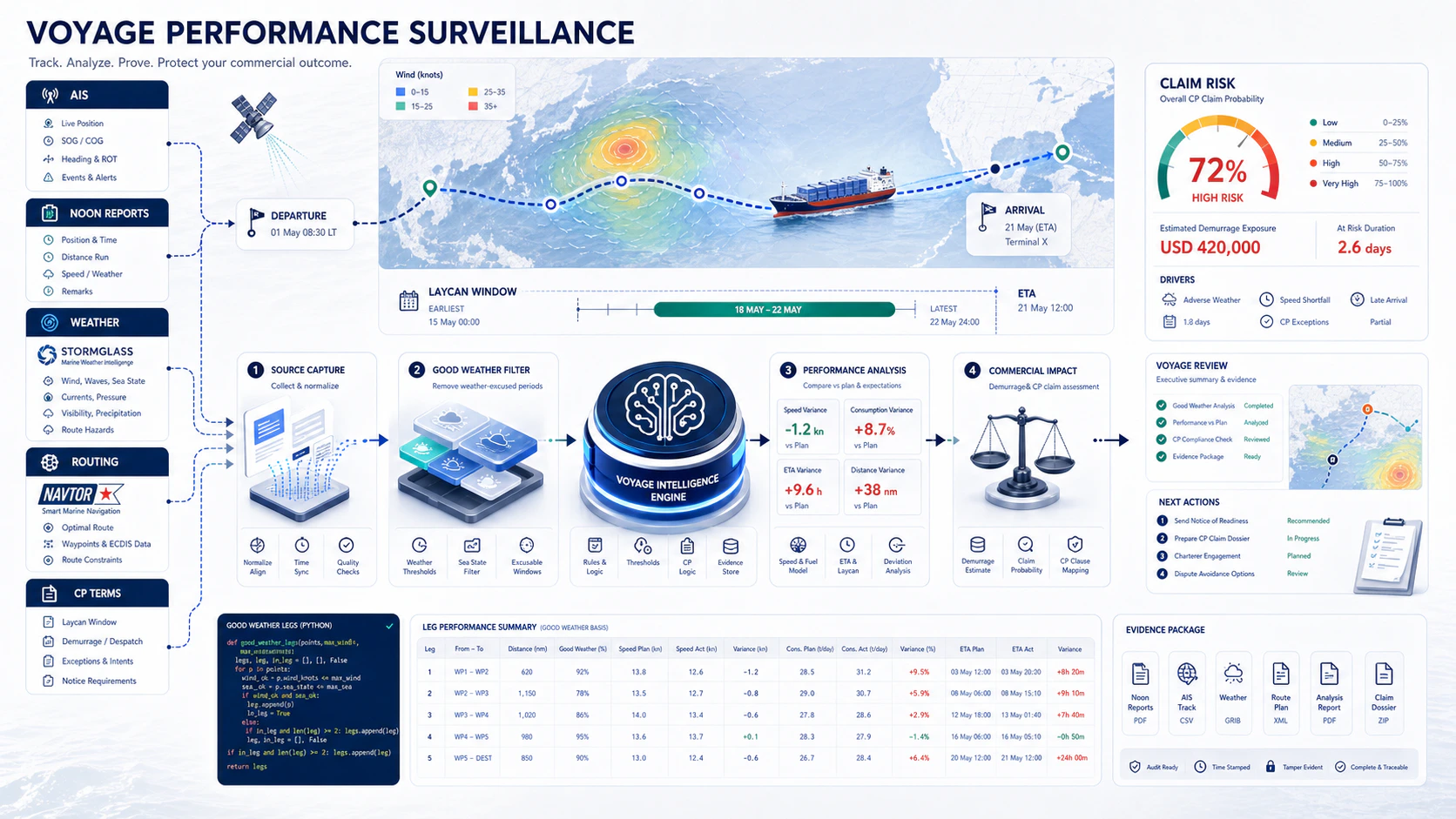
Voyage Performance Surveillance — AIS, weather, and noon reports filtered through Charter Party terms to produce per-leg performance and claim probability.
Where the data comes from
| Data | Source | Cadence |
|---|---|---|
| Position |  AIS (Automatic Identification System) + noon report AIS (Automatic Identification System) + noon report | Continuous + daily |
| Speed | Noon report | Daily noon-to-noon |
| FOC by grade | Noon report | Daily |
| Weather (wind, sea, current) | Noon report +  Stormglass + Stormglass +  NAVTOR routing feed NAVTOR routing feed | Daily |
| Routing analysis | NAVTOR (route optimisation) | Per voyage |
| Sea time / port time | ERP voyage log | Per voyage |
| Charter Party terms | CP file in vessel records | Per charter |
| ETA vs laycan | Voyage plan in ERP | Continuous |
| Port call data | ERP port module | Per port call |
- Vessel detail
- Fleet view
Single vessel with current position pinned and past 7 days of track history overlaid. Used when reviewing one voyage in detail.
Charter Party compliance — the central question
Most voyage analysis questions reduce to “is the vessel performing within Charter Party?” The CP defines a “good weather” envelope and a warranted speed-and-consumption profile within that envelope:Why weather filtering matters
Naively averaging speed across an entire voyage produces meaningless numbers. A vessel that hit a Beaufort 8 storm for two days and ran at 9 knots will look like a CP underperformer even if it ran at 14.2 knots through every good-weather leg. The pipeline applies the filter first, then runs the maths:ETA vs laycan
Beyond CP performance, the timeliness question:
Verdict:
The pipeline updates the ETA every noon report so a TSI sees drift as it happens, not at port-call time.
Claim probability
A composite that combines the deviation magnitude, the good-weather coverage, and CP wording sensitivity: The third term is what protects against weak claims. Low good-weather coverage means the data is insufficient to support the deviation either way — the score reflects that.Slow-steaming and bad-weather routing
Two patterns the pipeline flags specifically:Slow-steaming
A vessel deliberately running below CP speed (typically owner-instructed for fuel saving). Looks like underperformance unless the CP allows slow-steaming. The pipeline checks the CP terms and the master’s voyage instructions — if both agree, the leg is excluded from the deviation calculation.Bad-weather routing
When a master chose a longer route to avoid weather. Shows up as a longer voyage at lower average speed. Cross-references the fuel oil pipeline for FOC over the routed leg vs the rhumb-line projection — sometimes a longer route is the lower-cost option even though it looks slower on the speed metric.Worked example: a CP-claim case on MV POSUN
Voyage: Singapore to Rotterdam, 21 days at sea, laden.
Filtered to good-weather legs only:
Verdict: Sustained underperformance under good weather — claim probability HIGH.
The pipeline:
- Generates a CP-claim brief with the per-leg numbers, weather classification, and the deviation maths.
- Routes to the Commercial Operator (claim handling) and Technical Superintendent (root cause — fouled hull? Engine issue?).
- Cross-references with ME performance for engine condition signals and fuel oil for fuel-quality signals.
What the senior review contains
- Voyage map — current position, 7-day track, ETA marker.
- Leg-by-leg table — distance, speed, FOC, weather classification per leg.
- CP compliance — good-weather coverage, , , verdict.
- ETA vs laycan — projected arrival, demurrage / despatch implications.
- Claim probability — composite score with contributing factors.
- Bad-weather routing assessment — if a routing decision occurred, the cost-benefit analysis.
- Cross-domain notes — engine, fuel, hull-fouling signals that touch performance.
- Recommendations — operational, owner-communication, commercial actions.
- Escalation decision — to whom, and why.
Escalation triggers
Why the pipeline reads CP terms first
A voyage analysis without CP context misses the entire commercial dimension. A 0.5-knot deficit may or may not be a claim depending on CP wording — some CPs allow that as natural variation; others penalise it as breach of warranted speed. The pipeline reads the CP first, computes against the CP-defined envelope, and produces verdicts that map to the wording the lawyers will eventually argue over.Voyage analysis is one of the few places where the same numbers are read by completely different audiences — owner, charterer, commercial operator, master, TSI. The pipeline keeps all of them in one document so when the dispute starts, everyone is reading from the same numbers.
References
Templates: eta-voyage
ETA-voyage suite — single-vessel position with 7-day track and the fleet-wide map view.
Related: Fuel oil
Consumption deviation traces back to fuel quality or quantity in many cases.
Related: ME performance
Sustained underperformance under good weather often correlates with cylinder asymmetry or turbocharger fouling.
Related: Emissions
CII attained value is voyage-driven; ECA exposure depends on the route.